
Fine art architectural photography — what makes it collectible
Fine art architectural photography — what makes it collectible
Architecture is among the oldest subjects in photography. Buildings are patient. They do not move, they do not blink, they do not require permission to be photographed. And yet a photograph of a building that holds — that stays in the mind after the viewing is over — is far rarer than the subject seems to promise.
The difficulty is not technical. It is conceptual. A building photographed as a record of itself — as documentation of its form, its location, its condition — is an architectural document. A building photographed as a proposition — as an argument about time, geometry, human scale, or the relationship between structure and sky — is a work of fine art architectural photography. The camera is the same. The intention is not.
Architecture is built to last. The photograph decides what endures in memory.
This is the distinction that has defined the genre since its earliest practitioners. The great photographers of the twentieth century who turned to architecture — Julius Shulman, Ezra Stoller — were not documenting buildings. They were making arguments about what those buildings meant. Their photographs outlasted many of the structures they depicted. The images became the way those buildings are remembered. That is the power of fine art photography applied to the built environment.
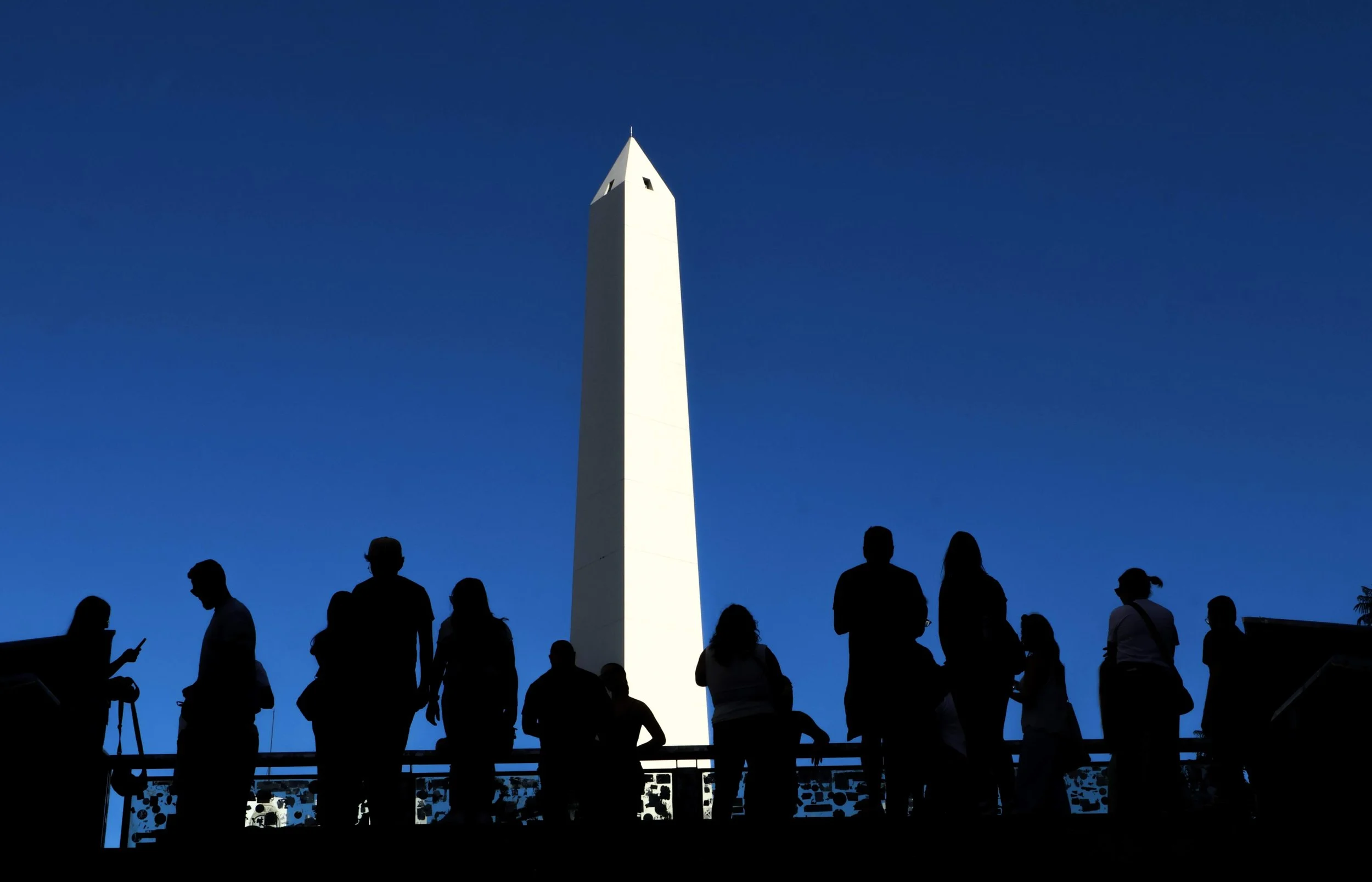
Buenos Aires obelisk silhouettes midday light fine art architectural photography
The building as subject
In fine art architectural photography, the building is never just a building. It is a vehicle — for ideas about permanence, power, geometry, or the human impulse to build things that outlast individual lives. The photographer’s task is to find the frame that makes that vehicle visible.
This requires a different relationship with the subject than documentation does. A documentary photographer needs the building to be legible — to be clearly identifiable, correctly proportioned, well lit for the purposes of the record. A fine art photographer needs the building to be resonant — to reveal something that the casual viewer would not have seen without the photograph to point it out.
The building does not move. Everything else — the light, the moment, the frame — is the photographer’s decision.
Consider what happens when a bird crosses the facade of a Gothic palazzo at the precise moment the shutter closes. The geometry of the building — centuries of calculated proportion — suddenly has an exception. A living thing interrupts the pattern. That interruption is not incidental. In Geometry’s Exception it is the entire argument of the image. The building provides the grammar. The bird provides the punctuation. Without the patience to wait for both simultaneously, there is no work.
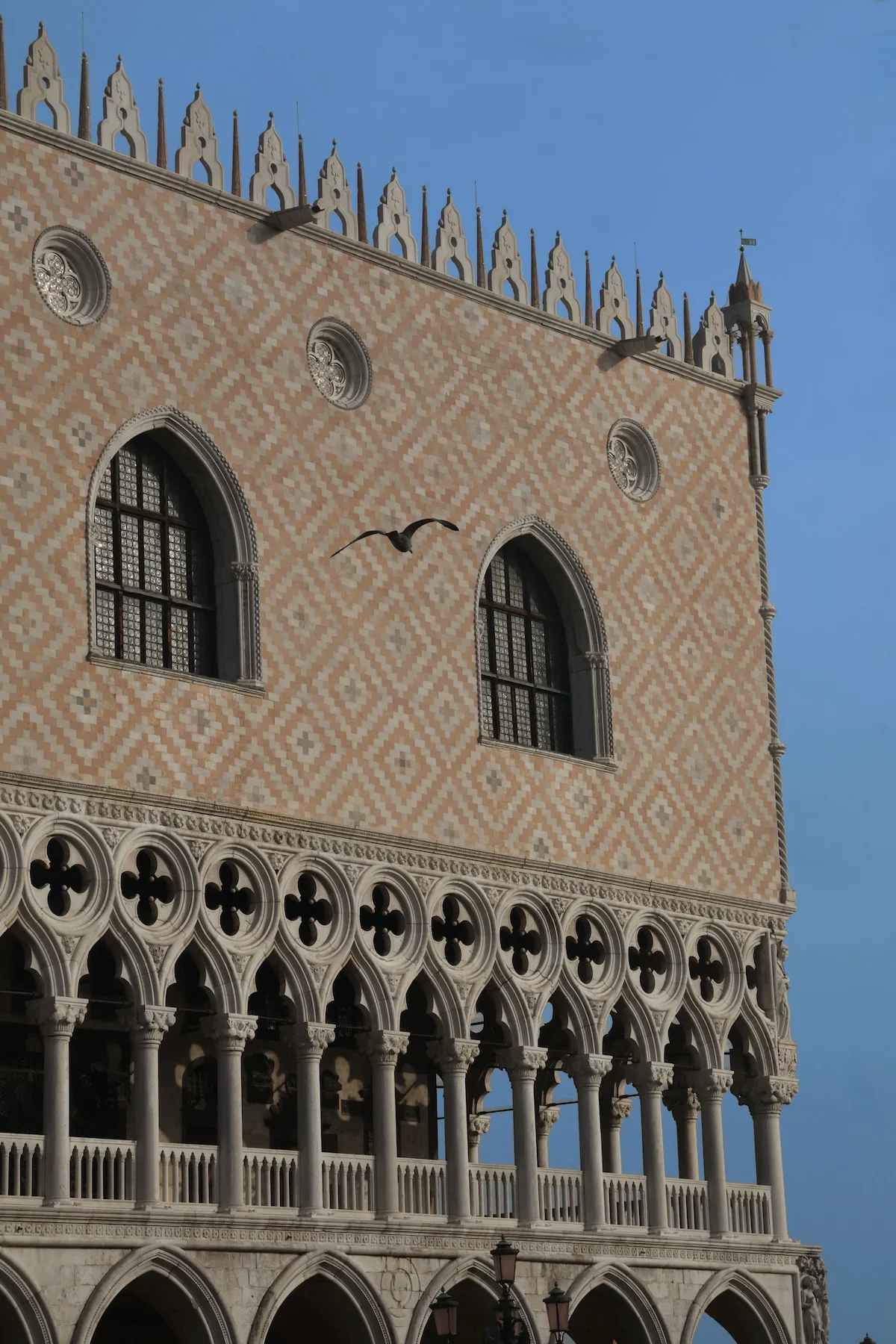
Bird in flight Venetian palace facade geometric pattern fine art architectural photography
Light and geometry
Architecture is geometry made physical. The fine art photographer’s task is to find the light that makes that geometry visible in the way it deserves to be seen — not just recorded, but understood.
Light falling across a facade at the wrong angle flattens the surface. The same light at a different hour rakes across the stone and reveals depth, texture, and the intention of the architect who designed the surface to be read in exactly that way. The photographer who knows how to read a building knows when to return. That patience is part of the work.
Geometry is the grammar. Light is the argument.
A colonnade of arches repeated across a hundred metres of Venetian arcade becomes something different when photographed from below and to the side, the repetition extending beyond the frame in both directions. The eye enters the pattern and cannot find the end. In Repeat Until Sky the title names the logic of the image: the pattern continues until the only thing that stops it is the sky. The geometry is the subject. The sky is the limit. The photograph is the proposition.
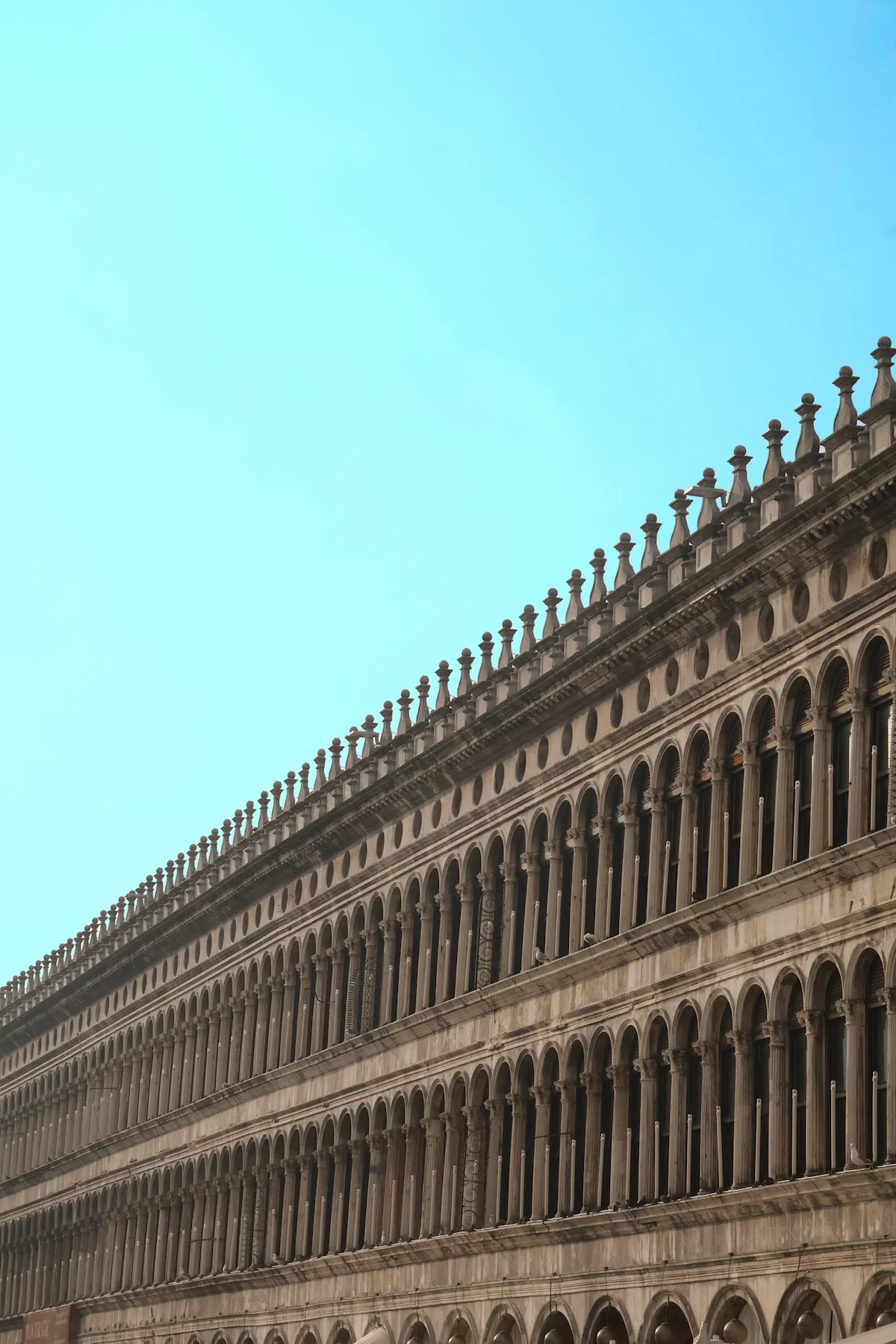
Venetian arcade repetition arches columns fine art architectural photography
See Repeat Until Sky in the collection.
Scale and presence
Architecture exists at human scale — it is built by people, for people, to be inhabited and experienced over time. Fine art architectural photography has the unusual capacity to remove the human being from that equation entirely — to show the building as it was designed to be seen, without the distraction of the crowd that surrounds it in life.
This is one of the reasons fine art architectural photography reads differently at large format. A print at 30 × 45 cm shows the image. A print at 60 × 90 cm creates an encounter. The facade fills the peripheral vision. The proportions of the building become the proportions of the experience. The collector who lives with a large format architectural work understands this — the work does not hang in the room, it inhabits it.
A large format architectural print does not decorate a room. It redefines it.
The facade of Ca’ d’Oro Eternal photographed against a turquoise sky — cut from its context, stripped of the Grand Canal and the tourists — becomes pure pattern. The diamond tiles, the Gothic tracery, the pointed battlements. The building is no longer in Venice. It is in the frame, in the room, on the wall. At size S it is a proposition. At size L it is a presence. At Pictelier every work is available in three sizes — S, M, and L — each framed specifically for that format, because the relationship between scale and architecture is never incidental.
For a full understanding of how format relates to presence and collectible value, the guide to fine art photography prints covers the relationship between scale, archival materials, and what the collector is acquiring when they choose a size.
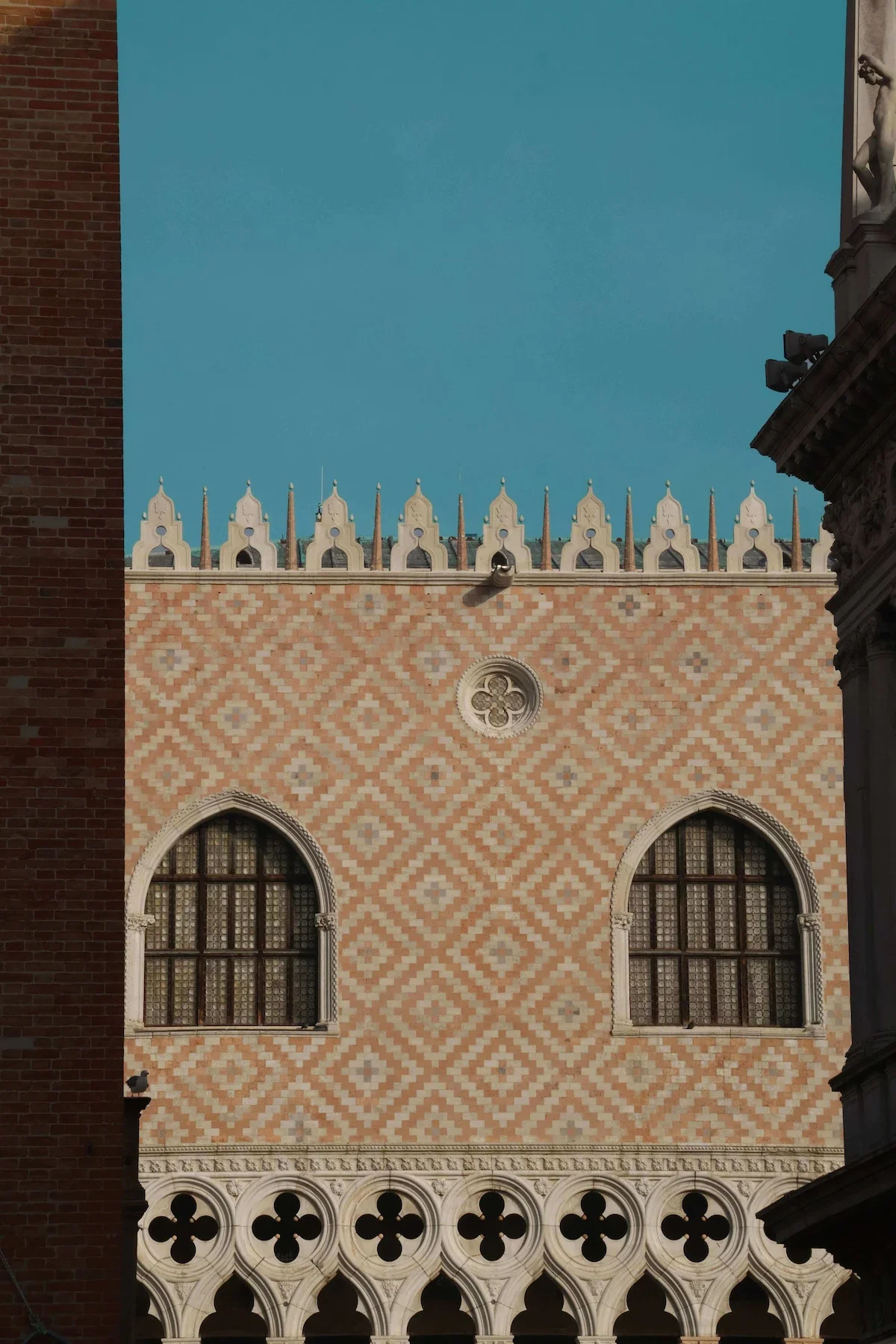
Ca d'Oro Venice Gothic facade geometric pattern turquoise sky fine art architectural photography
See the architectural works in the collection — View the works
What makes it collectible
Fine art architectural photography enters the collectible category when three conditions are met: the image proposes something beyond documentation, the production matches archival standards, and the edition is defined.
The first condition is the work itself — the image that could only have been made by someone who waited for the right light, found the right angle, and understood what they were looking at. The second is the object — printed on archival paper, framed to conservation standard, issued with a certificate of authenticity that records the edition number and the materials. The third is scarcity — a fixed number of prints beyond which no more will be produced.
A fine art architectural photograph in Edition of 5 is not a document of a building. It is a work that proposes a way of seeing a building — and exists in five copies in the world. The building may still be standing. The light that fell on it on that specific day, at that specific hour, captured in that specific frame, will not come again. That is what the collector acquires. For more on what distinguishes a fine art work from a reproduction, the guide to photography as art covers the distinction in depth.
The building existed before the photograph. The work exists because of it.
“I had been to Venice three times before I saw the Doge’s Palace the way this image shows it. The photograph taught me how to look at the building.” — K.A., Dubai
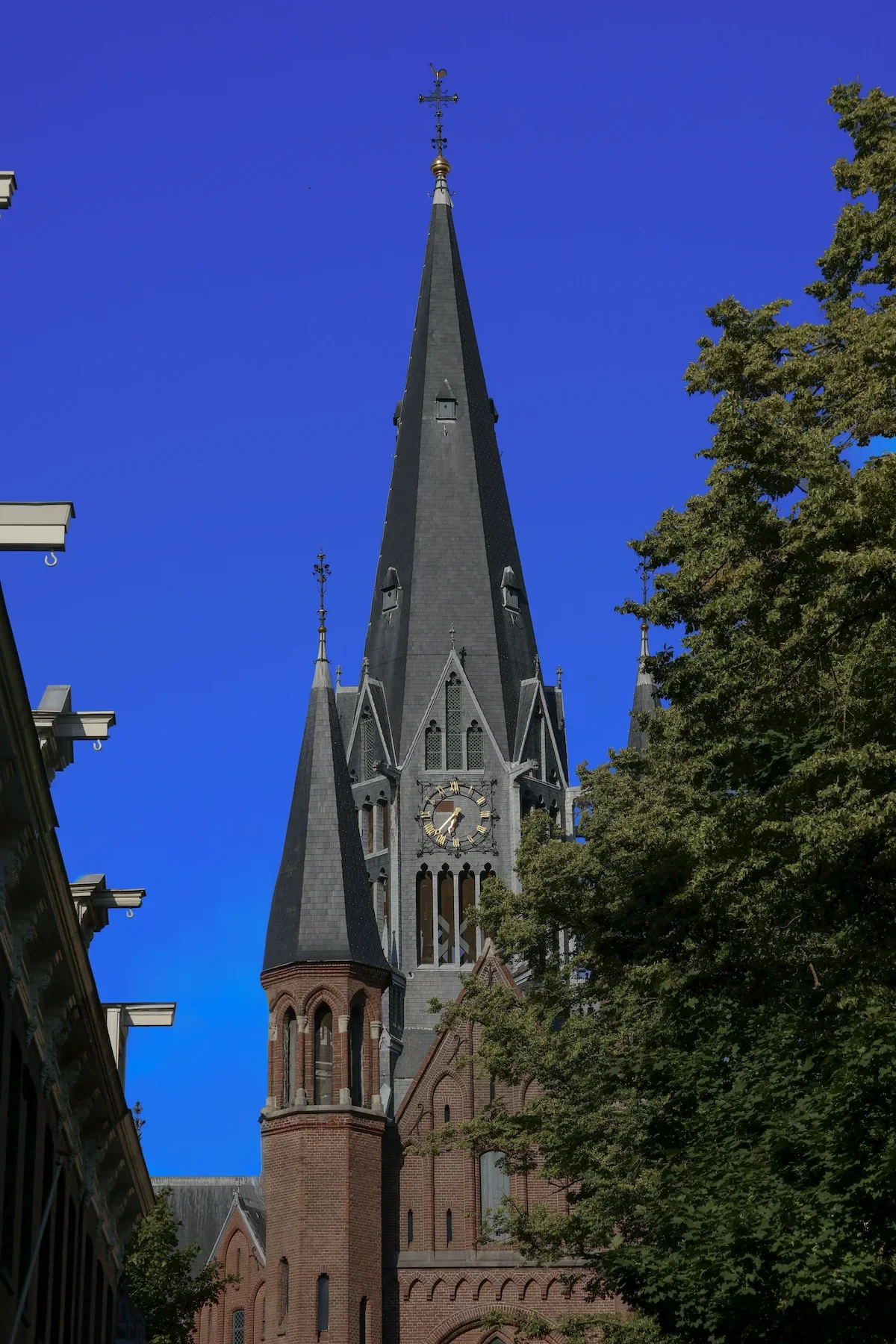
Amsterdam church tower destroyed New Year 2026 fine art architectural photography
Frequently asked questions
What is fine art architectural photography?
Fine art architectural photography is the practice of photographing buildings and structures with an artistic intention rather than a documentary one. Rather than recording the form and condition of a building, the fine art architectural photographer proposes a way of seeing it — through choices of light, angle, moment, and frame that reveal something about the structure that the casual viewer would not have noticed. The result is an image that stands independently as a work of art, not merely as a record of a place.
What makes architectural photography fine art?
Intention, specificity, and production. A fine art architectural photograph is made with a clear proposition — not to document but to argue. The image could not have been made differently without losing its meaning: the specific light, the specific moment, the specific frame are what give it its authority. It is produced on archival materials, issued in a limited edition, and accompanied by documentation that records its authenticity. The combination of these elements is what makes it a collectible work rather than a reproduction.
Is architectural photography considered fine art?
Yes, when the intention is artistic rather than documentary. Architectural photography has a long history as a fine art practice, with major collectors and institutions acquiring works by photographers who treat buildings as subjects for artistic investigation rather than documentation. The key distinction is whether the image proposes something — an argument about light, geometry, time, or human scale — or simply records what was there. The former is fine art. The latter is documentation.
How do I collect architectural photography?
Look for work that proposes something beyond the building itself — where the light, the angle, and the moment of capture are clearly intentional and could not have been replaced without changing the meaning of the image. Verify that the print is produced on archival materials and issued in a defined, numbered edition. Request a certificate of authenticity that records the edition number, the materials, and the atelier that produced the work. The work should arrive ready to place, framed to conservation standard. Inquiry-based ateliers — where the collector communicates directly with the artist — typically offer the most rigorous documentation and the most careful production.
What is minimalist architectural photography?
Minimalist architectural photography strips the image of everything that is not essential to the proposition. No people, no context, no incidental detail. The building — or a fragment of it — is isolated against sky or shadow, and the image finds its power in the relationship between form and emptiness. It is one of the dominant approaches in fine art architectural photography because it forces the viewer to engage with the structure itself: its geometry, its proportion, its relationship with light. The result can be both formally rigorous and emotionally direct.
The building existed before the photograph. The work exists because of it.
Explore the architectural works
Or inquire about a specific work.
Every work is Edition of 5, hand-framed in Amsterdam. Leave your name and the title of the work — you’ll hear back within 24 hours with availability and a custom mockup for your space
